
Seeing Survival
With Tracey Emin, giant maggots, and declarations of independence

I am very present. Blink-and-you’ll-miss-it present, a tourist on safari. Tracey is my guide, whispering softly, urgently in my ear. What she says matters. To her, and somehow to me. This is her gift.
The world dims as I enter a thin corridor; pupils narrowing, rods playing catch-up, disorientated. As I dark adapt, small Polaroids come into focus on my right. There is black lace, deep cleavage, gold chains, a woman’s face etched and angular. Irritation prickles my skin; I didn’t come for these tired tropes. Challenge me. Change me. Please.
Tracey whispers: “And this was a time in my life where I liked myself, I liked the way I looked.”
I see this. I believe it, because it is her. But familiar thoughts shimmer: Who is she trying to please? Is this what ‘liking myself’ should look like? Was she pressured by a sleazy man serving a seedy society? My sensor/censor has been coded this way since childhood. It is hardwired.
I look to my left. A moist, pink, giant maggot mouth is snapping at me. I am terrified: adrenaline surging, glucose dumping, paralysed. For a second, less than a second, I am pure recoil. Then I understand what I am looking at, and recoil gives way to worse: recognition of the recoil.
Tracey is calm: “On the other side we have photos which are to do with my cancer and to do with my stoma.”
Not from Doctor Who: The Green Death, then. Pictures of her stoma, an opening made from intestine and brought to the skin after her cancerous bladder was removed, so urine can leave her body. Nothing monstrous. Just healthy, vascular, functioning mucosa, a successful rerouting. Life-saving.
I should have known this. I have witnessed orificial secrets and secretions, seen the ins-and-outs of intestines. But until this moment, I’ve never seen a photograph of a stoma.
Have you?
My instinctive reaction lasted a microsecond, but the inexplicable, inexcusable absurdity of it lingers with the brittle, hyperaware aftertaste of a double espresso.
When I get home, I look up Self-Portraits on the Tate website. There are no stoma pictures. The accompanying image is from the “right” side. Of course. A weary wariness crawls over me: was this choice arbitrary or precautionary?
Perhaps I’m being unfair. Institutions can’t afford to take risks. They have to go with the selfie of a woman in her lacy bra, an image so ubiquitous it has become innocuous.
Women are programmed to ceaselessly consider how we look, to feel proud of some versions, mortified of others. The flawlessly beautiful and the surgically scarred are equally caged, as are all of us in between, specimens in a menagerie. I’ve yet to meet a woman who has escaped the oppression of physical scrutiny. I would like to. Just let me check my lippy first.
I search Google. I am becoming wolf-like, prowling, hackles-up. Her stoma pictures are nowhere.
I find a newspaper headline. “Tracey Emin shares graphic picture of her stoma on Instagram” Beneath it: “*Warning, the following article contains graphic images some readers may find distressing*.”
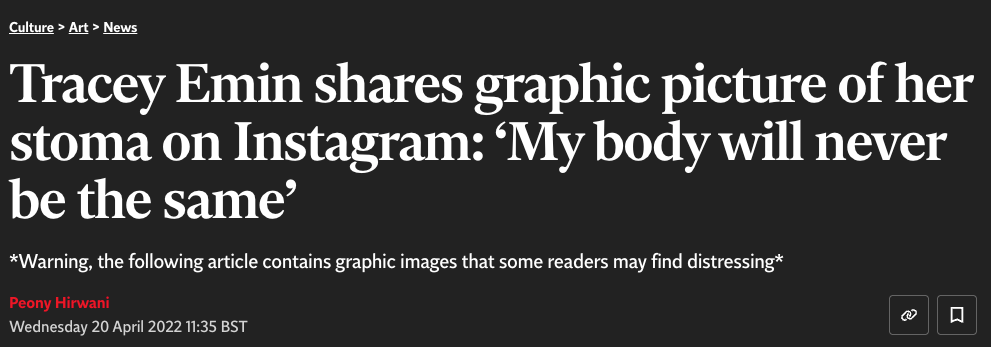
Distressing? Because it reminds us that we are mortal? That we might get sick? That our lives might be saved? Terrifying alien maggot mouths and brain-hacking spiders are fit for tea-time family entertainment, but an image of a life-saving alteration to human anatomy is a public biohazard, unfit for a newspaper?
Or is it about protection? Of patient dignity? Of public decency? Of the fragile line between visibility and spectacle? Of the child who might open a newspaper and be disturbed by a distortion of the human form?
Newspapers entered my life at about the same time as the maggots. I would sit on the living room floor with my legs spread to almost 180 degrees, so I could open the paper between them. Chin propped on my elbows, I’d pore over the fashion pictures; the white, willowy, fantastical women as alien as Cybermen. Then I’d try to read the news, first because I was one of those kids who aped her father for approval, then because I was one of those kids for whom words were worlds.
We did not get a ‘tabloid’ newspaper delivered, but if we had, turning the front page might have put me nose-to-nipple with a topless girl; a beaming beauty with bare, bountiful breasts that had negotiated an exemption deal with gravity. The topless Page 3 girl was a British staple for 44 years. No plastic wrapper, no top-shelf isolation, no age restriction, no place restriction.
For 44 years, millions of British households served toast and bare breasts for breakfast. That’s about 28,000 breasts. Lined up nipple to nipple, they would stretch the length of a football pitch, twice over, with enough left to wrap round the halfway line.
Page 3 confused me as a child. Not the ethics, I was always clear on that. The architect: Larry Lamb, who introduced the first Page 3 girl in 1970. I never saw Larry Lamb, but I saw plenty of Larry the Lamb, adorable mischief-maker in TV’s ToyTown. I’m sure I must have known they were not one and the same, but Larry Lamb, soft-porn peddler, is still a bit downy-soft in my mind.
Page 3 seemed more confusing as I got older. Not the cynical degradation of women for profit, I remained clear on that. The contradictions. Everyone was fighting about what could be shown, and no one was paying attention to what had to be concealed.
As a doctor on a high-risk breast cancer unit I talked to many women about mastectomy. The fear of no longer being acceptable skulked in the corners of every conversation. I tried to reassure them, of course, but the paradoxes were sitting with us in the consultation room, gripping their other hand.
Breasts enlarged for fantasy were printed by the millions. The marks of removal, of survival — the mastectomy scars, the stomas — are still almost unpublishable: barred by algorithms, bannered by newspapers.
And who am I, recoiler, to reassure? I am a vat of paradoxes. I hate the tyranny of thinness, but my day feels better when my jeans feel looser. I believe we should be at ease in our bodies, but I wait for a cubicle at the swimming pool. I know, unwaveringly, that a ‘normal’ body should not be valued more highly, but I have not lived by that conviction. I do not have Tracey’s steadfastness.
Back in the exhibition, I am smiling, and soft-singing Sylvester’s “You Make Me Feel (Mighty Real)”, the glorious coda to Emin’s “Why I Never Became a Dancer”. She really got me with that Self-Portraits corridor; I stepped into her rope and she dangled me upside down from my assumptions.
Wandering through “A Second Life”, Tate’s celebration of 40 years of Tracey Emin’s unapologetic practice of being herself, is like being in the TARDIS; the inside has become infinite. She decides what has value, what is shallow; what to show, what to hide. She is a performance artist devoid of performative artifice. King of her jungle. Totally independent. She decides and she declares.
She makes me feel mighty real.
It is a gift.
In 1776, another declaration of independence was being inked in the swelter of a Philadelphia summer. Fifty-six men risked life and liberty to sign one of the most consequential declarations in human history.
That same year, across the Atlantic, a different declaration was being cut into Mr Morel, a wine merchant of Vert-Galant. As America was declaring independence from Britain, Morel sought independence from his cancer-blocked bowel. He travelled to Rouen to consult Monsieur Pillore, a pioneering surgeon who had studied Littré’s radical ideas of surgically treating intestinal blockages. Surrounded by sceptical colleagues, Pillore bypassed the unremovable cancer by attaching a healthy section of intestine to Morel’s skin, creating the first surgical stoma. 1
Two hundred and fifty years later, medicine has normalised the stoma. Why hasn’t culture? Thirteen million people are living with stomas today: babies with birth defects, teenagers with inflammatory bowel disease, adults with cancer, people injured, infected, obstructed. Out of options. If you shook each one by the hand it would take over five months. I’m not expecting fireworks and parades, but maybe a change of perspective is overdue.
Alongside the famous rights to life, liberty and happiness, the Declaration also chastises us: “mankind are more disposed to suffer, while evils are sufferable than to right themselves by abolishing the forms to which they are accustomed.“ Indeed.
It is self-evident that there is nothing intrinsically shocking or shameful in scars or stomas. We have made it so. We have become accustomed to seeing one red opening as violence and revulsion, while others — the orchid throat, the blooming rose, the sun — are allowed to mean beauty, life.
The cost of hiding is paid at the moment someone most needs to be found. Waking from surgery to meet an alien body they don’t know how to recognise. A body their family does not know how to see. Their lover does not know how to touch. The algorithms don’t know how to declare. Survival mislabelled: graphic, distressing, obscene.
And yet, as I have been writing this, new confusions scuttle around my ankles like those tormenting spiders. The maggots were not new. They have a habit of pitching up when I’m shocked. Maybe my childhood tea-times should have been protected.
And survival is rarely easy and never pretty. Emin has been candid about life with a stoma, the leaks and bleeding, the fatigue, the pain, the endless planning of bags, toilets, travel. Gratitude does not cancel grief. Defiance does not cancel despair. She has declared it all.
So it is about independence. The right to choose what to show, but also what to hide. To cover, reconstruct, disguise, decline. To close the door. Concealment is not always oppression. Sometimes it is comfort, dignity, control.
But concealment should not be prescribed. This is what I believe, unwaveringly. Can I live by it? Can we?
Page 3 was never formally banned. Each defeat scarred me, but people kept campaigning, sponsors slowly shifted, editors recalibrated, and after 44 years, Page 3 put its top on.
Society moved. And it is moving now. In five minutes of searching, I find CensHERship, Invisible, #FreeTheStoma. I decide to write to Tate and ask them to include a stoma picture on their website.
It is in our gift.
Amussat, Jean Zuléma. Mémoire sur la possibilité d’établir un anus artificiel dans la région lombaire sans pénétrer dans le péritoine. Paris: Germer-Baillière, 1839, pp. 84–88. The details of Pillore’s groundbreaking 1776 operation on Mr Morel were nearly lost to medical history. For decades, prominent surgeons (including Dupuytren, Velpeau, and Fine) vainly sought the clinical notes from Pillore’s descendants. Amussat himself personally traveled to Rouen to request the records from Pillore’s son and grandson, but was initially unsuccessful. It was only at the last possible moment, just as Amussat was printing this 1839 memoir, that he asked once more and the family finally located Pillore’s original, precious observation.
I liked this line: "Everyone was fighting about what could be shown, and no one was paying attention to what had to be concealed." It makes me think that often, there is an unspoken societal pressure; we don't know where it's from, but we rarely question it. And those that "must" be concealed sometimes are what need to be seen the most.