
The Grace in Being a Burden
All Give and No Take (a song)

Sometimes. When I’m writing. The wind drops and the words whipping across my eyes, the phrases catching in my mouth, the sentences snagging round my fingers, the whole maddening, untameable mess of it, settles.
There, on the page, is a sleek Wintour bob of an essay. Structure. Shape. Swing. It holds when I turn my head.
We are 20 minutes late: my mother wouldn’t get in the car, I couldn’t find the address. So far, so normal.
“Oh my, with your bone structure you will have so many options. Come in. Come in.”
My mother preens into the compliment, her self-declared swan neck elongating luxuriously. I concertina, my tension dissolving like a suspended chord.
Maybe it will be okay.
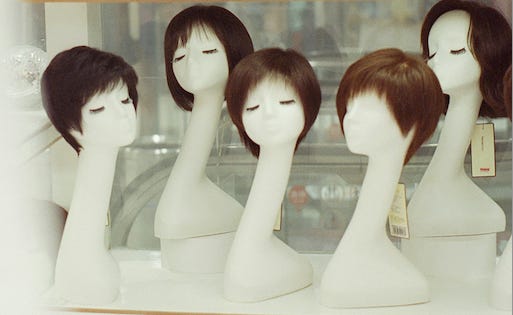
We step into a small room filled with ranks of bodyless, faceless plastic heads. They have no eyes, but somehow each one is watching me, judging me. There is a whiff of serial killer in the air. I didn’t tell anyone where we were going.
“You can sit over there.”
Salt-of-the-earth Sue breaks the spell and I am dismissed to a corner. I find myself shrinking into the wall of dummy heads behind me, their blank serenity closing over me like a shroud. It is a relief. To be incidental.
“You, my lovely, should sit right here.”
For the next hour Sue attends to my mother bringing out wig after wig. Long, short, sensible, glamorous, affordable, exorbitant. My mother receives each like Cleopatra accepting tribute. Chin lifted, head turned slowly left, then right. No smile, no commentary, just the occasional nod to one that makes the cut. Each wig looks sensational, even the platinum-blond crop.
She really did have exquisite bone structure.
I thought she would choose something familiar, something fine and feathery that she could casually up-do for self-declared careless beauty. Something similar to herself. Before. Before she was ill, before she was unlucky, before she lost her hair unexpectedly to a drug she might not have needed, didn’t want; that I persuaded her to accept.
But she goes for a chic, glossy, shoulder-length bob with a side parting and attitude.
Sue packs it up, cushioned in pillowy tissue paper, and Mum hugs the huge box to her tiny lap on the journey home, her bony fingers clasped round its corners.
We don’t say anything.
It was the best day I spent with my mother.
Let me comb your hair
Carry your bones to the chair
I’ll make the tea
Won’t be too weak
Please let me do just one thing
Sometimes. When I am writing a song. It reveals itself like playing peekaboo. There, gone. There again. Glimpses that beguile then duck away.
I circle it. Tease it out. Come at it sideways. A line appears, then another. I’m not quite sure what it’s about, what I’m about. A moment? A monument? A mausoleum?
Then the song looks back. It always knows first. Fingers part. “Peekaboo.”
And there I am.
Don’t bat me away
Don’t say we’re the same
How could I escape
Your hand on my brakes
Please let me do
One thing for you
Some women shaved it all off before the first cycle, owning the loss before it owned them; others endured the numbing pain of the cold cap, rigid but resolved beneath their blankets; some wrapped their heads in exuberant headscarves or wore earrings bold enough to draw the eye; there were baseball caps, turbans, beanies, wigs of every colour and shape; some ignored it, focussing on other pressing negotiations; and some — many — mourned the nightly losses strewn across the pillow, the sorry casualties clumped in the hairbrush, the fallen strands clinging to the plughole.
In the six months I worked on the chemotherapy ward no two women handled hair loss the same.
It was never about vanity.
It was about identity. About control.
Hair was only the most visible recalibration. Hundreds of negotiations begin, never end, when we become ill. Even a glass of water can acquire the weight of a debt, a compromise, a schism, as Natasha Steer lays bare in “The Kind of Person People Take Care Of.”
Why do we only trust love
When it gives us a job to do
Shoulder or saviour
Debt fabricator
Being no trouble
Look see how I’m lovable
My first Small Matter was about the difficulty of sharing work before we’ve given it everything. About the anxieties of whether it is substantial enough, matters enough, is worth taking up space in someone else’s day.
Dolores Lucero pointed out what I had missed. A smaller piece might not be less generous. It might be more so. Less to ask. Less to carry. A pebble, not a boulder.
I was measuring what I was giving, but not what I was asking others to receive.
Illness makes our negotiations with burdenship impossible to ignore. But most of us dance this line all the time: in the extra work we silently absorb, the offers of help we wave away, the standards we set before letting anything leave our hands, the almost autonomic reflex to make ourselves useful before we make ourselves needful.
But being no trouble can become its own kind of trouble.
Why do I only feel safe
When my hand is on the wheel
No burden, no grace
All give and no take
I gotta change
Sometimes. I know what I ought to do. I have turned it over, worried at it, made the lists, run the permutations. I know what it costs. I know what it will give. I can see the path from here to there.
And still, nothing moves.
Not quite I don’t do it. More that it remains undone. The way we can be giving up smoking, getting fit, writing the book, making the call, for months. Years. Dug in somewhere between intention and action, in the no-man’s-land of changing.
But it’s hard
And I’m not really up for it.
But today is not one of those sometimes.
Today I share with you a dishevelled germ of a song, All Give and No Take. First pass, one take, bare vocal, a few ivories. It’s hard. I’m really not up for it. But for this day, at least, I am up to it.
I don’t know if it’s a burden or a gift.
I don’t always have to know.
Thank you for this, Naz. A beautifully poignant song.
I can see the threads of give and take, and the liminal in-between-ness, in your piece.
How beautiful Naz, I felt this deeply ❤️ I lost my Dad almost a year ago x